What an Auto Body School Near Me Teaches: Real Skills for a Hands-On Career
If you enjoy working with your hands, solving mechanical puzzles, and seeing a visible result at the end of the day, auto body repair might be a natural fit. The work goes beyond hammering out dents and spraying paint. A solid training program builds a mix of technical knowledge, problem-solving habits, and professional judgment that translates directly into a job at a collision center, a dealership shop, or a specialty restoration garage. Knowing what those skills are can help you decide whether this trade is right for you and what to look for in a school.
Metal shaping and panel repair
The core of auto body work is returning damaged metal to its original shape. Students learn to read the way steel and aluminum behave under stress. A dent that looks simple on the surface may have pulled the surrounding panel out of alignment. Training covers how to use hand tools like body hammers, dollies, and pick tools, as well as power tools such as pneumatic planishers and shrinker-stretchers. You also learn when to apply heat and when to avoid it, since overheated metal can warp or lose its strength. The goal is not just to make the panel look straight but to restore its structural integrity so the next coat of filler and paint bonds properly.
MIG welding and structural joining
Modern cars use a mix of high-strength steel, aluminum, and sometimes advanced alloys. A good program teaches MIG (metal inert gas) welding, which is the standard method in collision repair. You learn to set amperage, wire feed speed, and gas flow for different thicknesses of metal. More importantly, you practice controlling the puddle and moving the torch at a consistent speed. Beyond the weld itself, you study how to cut out damaged sections and fabricate replacement pieces from sheet metal. The skill is not just running a bead, it is knowing how to plan a repair so the final joint matches the factory strength and appearance.
Body filling and surface preparation
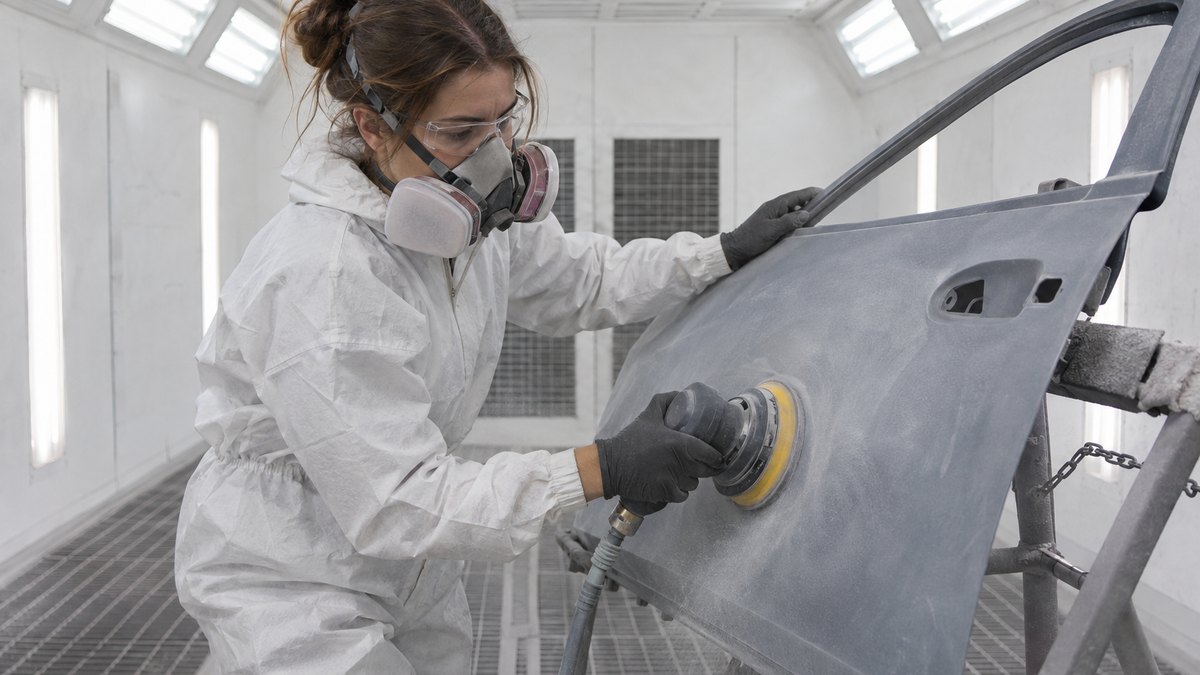
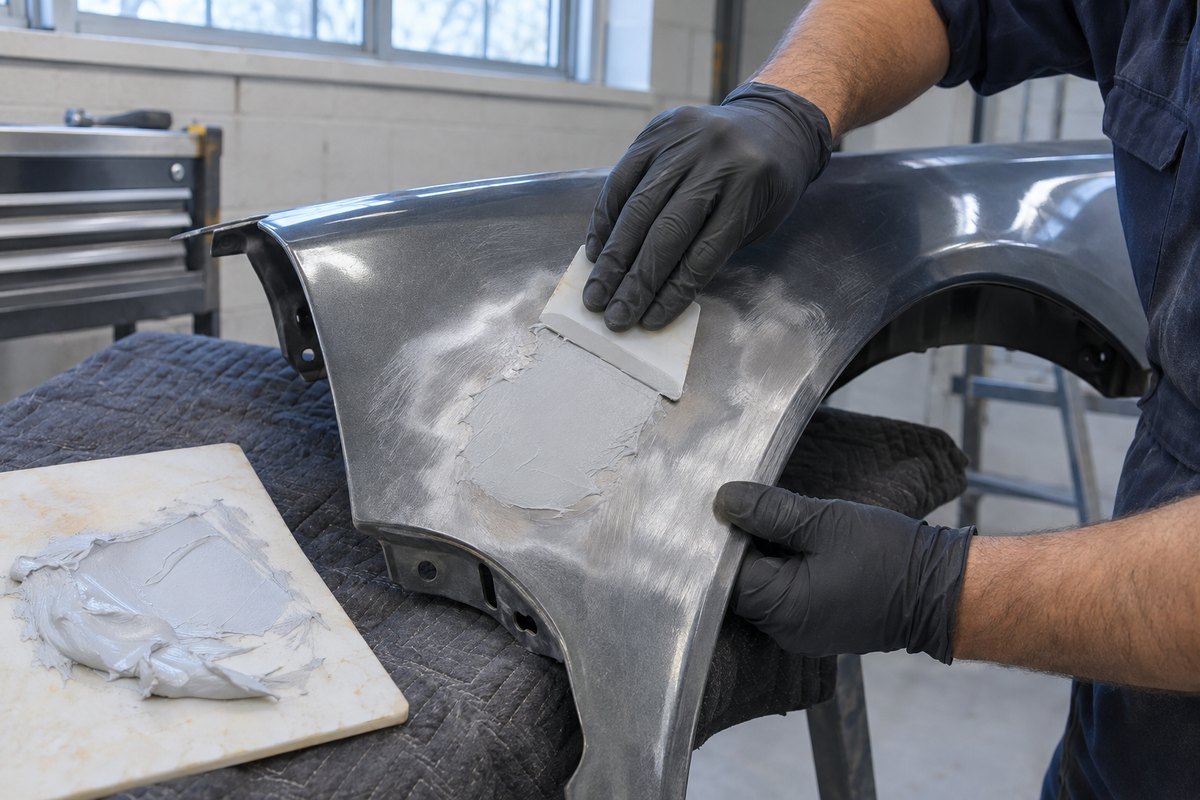
Even the best metalwork leaves small imperfections. Auto body training covers the chemistry and technique of polyester fillers, spot putties, and primer surfacers. You learn to mix hardener and catalyst in exact ratios, apply filler in thin layers, and block-sand each coat to a smooth contour. The real nuance is knowing when to stop sanding: too little leaves a visible low spot, too much burns through to bare metal and creates a new problem. Students also practice feathering paint edges, masking complex shapes, and cleaning surfaces to avoid contamination that causes fish-eyes or adhesion failure later.
Spray painting and color matching
Paint is the final layer that a customer sees, so a school devotes serious time to spraying technique. You start with primer and move to basecoat and clearcoat, learning to adjust gun distance, fluid flow, and fan pattern for different paint systems. Color matching is a separate skill: reading the paint code from the vehicle, mixing tint to formula, and then spraying test cards to check the match under natural and artificial light. Metallic and pearlescent finishes are especially tricky because the flake orientation changes with spray angle. Training also covers solvent handling, booth safety, and the proper use of respirators and fresh-air systems.
Plastic and composite repair
Modern cars use plastic for bumpers, trim, and some body panels. Repairing these materials requires different methods than metal. Students learn to identify plastic types by burn test or resin code, then apply two-part epoxy adhesives, plastic welding guns, and reinforcing mesh. For fiberglass parts, you practice laying up mat and woven roving with polyester or epoxy resin, then fairing the surface to blend with the surrounding area. Composite repair is especially valuable because it is a growing area in automotive manufacturing and a skill that fewer technicians have.
Structural alignment and measuring
A vehicle that has been in a collision may have a twisted frame or misaligned mounting points. Training covers the use of tram gauges, centerline strings, and laser measuring systems to check body panels and underbody structure against factory specifications. You learn to identify pull zones and push zones on the frame and to plan the sequence of pulls and pushes so the structure comes back square without overstressing any one area. This part of the work is closer to engineering than to craftsmanship, and it is critical for safety: a frame that is off by even a quarter-inch can cause uneven tire wear, misaligned doors, or poor crash performance in a future impact.
Estimating and customer communication
Auto body repair is a business, not just a craft. Many programs teach students how to write an accurate damage estimate. You learn to use estimating software, break a repair into line items, calculate labor hours by operation, and order the correct parts. You also practice explaining the scope of work to a customer in plain language: what will be repaired, what needs to be replaced, and why. This skill is often what separates a technician who stays in the shop from one who moves into a management or ownership role. It also helps you spot when an estimate from an insurance company is too low or missing a necessary step.
Safety and workplace habits
Every body shop has hazards: sharp metal edges, heavy parts, chemical fumes, grinding sparks, and high-pressure spray equipment. Training instills the discipline of wearing proper PPE, keeping a clean work area, and following lockout/tagout procedures for pneumatic tools. You learn the correct way to lift a door panel, how to support a vehicle on a lift, and what to do if a fire starts in the paint booth. These habits are not just for passing a test, they keep you healthy over a 30-year career. A good school also covers the basics of hazardous waste disposal for paint, solvent, and used filler materials.
How a tuition-free program changes the picture
Many people assume that trade school means taking on debt. That assumption keeps some talented students from exploring the field. Programs like the one at Newgate School in Minneapolis offer a different model: the training is entirely tuition-free, which removes the financial barrier and lets students focus on learning the trade. In a tuition-free program, the time you spend in the shop is not shadowed by the worry of how to pay for it. You can take the time to practice a difficult weld, redo a paint coat, or ask the instructor to explain a technique again. That kind of focused practice is exactly what builds mastery.
What to look for in an auto body school near you
When you evaluate a school, ask about the balance between classroom theory and hands-on shop time. A program that is 100% hands-on, where you work on real vehicles from the first week, will teach you faster than one that relies heavily on lectures. Also ask about the condition of the equipment: are the spray booths filtered, are the welding machines current, is there a dedicated paint mixing room? Talk to current students about the instructors’ experience. A teacher who has spent years in the field can show you shortcuts and trouble spots that a textbook never mentions. Finally, check the program’s connections with local employers. A school that places graduates directly into shops has a curriculum that matches what the industry actually needs.
The skills you build in auto body repair training are practical, varied, and in demand. You will learn to shape metal, weld, paint, fill, measure, estimate, and communicate. More than that, you will develop the judgment to look at a damaged car and know exactly what it needs, in what order, and how to do it safely. That kind of competence is what makes a career in this trade both stable and satisfying.
Ends · THEAUTOMOTIVEEDUCATIONREVIEW